 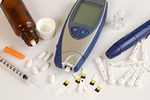     
Diabetes
Who
suffers from diabetes and why is it relevant to me?
As the number of people with diabetes continues to increase and as thousands
still walk around undiagnosed it is a big health problem.
What
symptoms should I look for ?
Increased
thirst
Going to the loo all the time –
especially at night
Extreme tiredness
Weight loss
Genital itching or regular episodes of
thrush
Blurred vision.
Type
1 diabetes develops
much more quickly, usually over a few weeks, and symptoms are normally
very obvious.
Type 2 diabetes develops
slowly and the symptoms are usually less severe. Some people may not
notice any symptoms at all and their diabetes is only picked up in a
routine medical check up. Some people may put the symptoms down to 'getting
older' or 'overwork'. People who are overweight
are particularly likely to develop Type 2 diabetes.
It tends to run in families and is more common in Asian and African-Caribbean
communities.
People
at an increased risk of developing Type
2 diabetes include:
People who are overweight People who have a family history of diabetes White people aged over 40 and People from black and minority ethnic groups aged over 25 Increasingly, many more people are being diagnosed at a much younger age.
The reason diagnosis is so important is that diabetes can affect other parts of the body. As so many people are undiagnosed for years , other complications can have arisen by the time they are aware they have diabetes. Complications include heart disease, stroke, blindness, kidney failure, and nerve damage .
Could you be at risk of Type 2 diabetes - leading charity Diabetes Uk tells us more?
There are 3.8 million people in the UK with diabetes, the vast majority with Type 2, and by 2025 there are projected to be 5 million people in the UK with the condition. Left undiagnosed or poorly managed Type 2 diabetes can have a devastating impact, not only on the person who has the condition but also on the lives of their family.
Once people have their risk checked, either online - www.diabetes.org.uk/risk - or by visiting a pharmacy, those at high risk will then be asked to visit their GP for a test for Type 2 diabetes and given information about how to reduce their risk.
“As well as identifying those at high risk, the campaign is expected to identify some of the estimated 850,000 people in the UK who have undiagnosed Type 2 diabetes,” says Libby Dowling, clinical advisor at Diabetes UK. “These people will then have the chance to start managing their condition and so reduce their risk of developing long-term complications.”
Risk factors
“Being over 40, or over 25 if you are of South Asian origin, is a risk factor,” says Libby. “Also, having a history of Type 2 diabetes in your family increases your risk of developing Type 2 diabetes. If you are overweight this also significantly increases your risk. A good way to find out if you need to lose weight is by measuring your waist. Having a waist size over 31.5” if you are a woman, 35” if you are an Asian man or over 37” for all other men puts you at greater risk of Type 2 diabetes.
Complications
Blindness, amputations, kidney failure, heart attack and stroke are just some of the complications that Type 2 diabetes can lead to. “Some people mistakenly believe that Type 2 diabetes is a ‘mild’ condition,” warns Libby. “If it’s detected early and well managed it’s possible to live a long and healthy life. But people need to understand that if it’s not it can have very serious repercussions.
“People often tell us that they buried their heads in the sand about their Type 2 diabetes and didn’t make the necessary adjustments in their lifestyle or didn’t bother taking their medication. They now regret it because their condition has had a massive impact on their life and they are now facing health problems.
“The good news is that for many people, finding out they are at high risk of Type 2 diabetes or being diagnosed with it can be the start of a process of turning their lives around. Some people who were at high risk of the condition have lost weight and their risk has reduced as a result. For those who have already been diagnosed with the condition, making the necessary adjustments to their diet and lifestyle can have a huge impact on the successful management of their Type 2 diabetes. Sticking to the medication prescribed for you and ensuring you get the health checks you are entitled to – visit www.diabetes.org.uk/15-essentials - will also help.”
Elaine’s story
Elaine Clark’s husband John died in 2008 at the age of 51. He was diagnosed with Type 2 diabetes in 1990 but did not change his lifestyle. “Despite the diagnosis John still smoked, drank and indulged in takeaways,” says Elaine. “If he had to queue too long at the doctor’s he’d leave before his appointment.”
John lost his sight in 2000 and in 2007 he had a stroke. He suffered from severe hypos and wasn’t eating. He was in hospital for 17 weeks and lost 6 stone and spent the last 3 weeks of his life in a nursing home.
A few months ago Elaine discovered her son Matt, who is only 31, had been diagnosed with Type 2 diabetes. “It’s been a blow for us as a family but Matt has reassured me that he will face his Type 2 diabetes and not ignore it like his Dad did,” she adds. “He’s determined to make the necessary changes to his lifestyle and look after himself so he can fulfil his potential for himself and all his family, including his new-born daughter.”
Adopting a healthy lifestyle
“Making healthy lifestyle improvement does not have to mean spending hours at the gym or giving up all their treats,” says Libby. “If people want to reduce their chances of developing Type 2 diabetes then making small changes that you can stick to in the long term is a good approach. Up the amount of vegetables and fruit you eat and reduce your intake of sugar, fat and salt. Try to have more meals cooked from scratch, so you know exactly what’s in them. And check the food labels carefully on ready meals and go for ones that are low in fat, salt and sugar.
“When it comes to exercise it’s great to do some walking and make exercise part of your everyday regime. So try and walk instead of always getting in the car to make a short errand. Or take up something that you know that you will enjoy and stick to, such as cycling or going dancing.”
Here to help
If you would like to speak to someone from Diabetes UK then contact the charity’s Careline on 0345 123 2399.

Nutritional
consultant Jessica gives some suggestions for people with diabetes.
To arrange for a personal consulation please click here    |
Nutrition
and diabetes
As with all aspects of nutrition the relationship
between eating carbohydrates (cereals, fruits and vegetables)
and type 2 diabetes, (late onset diabetes) is complex. Diabetes
disrupts the mechanisms by which the body controls blood sugar.
Eating refined carbohydrate-containing foods, whether high in
sugar or high in starch (refined cereals, potatoes, etc), sharply
raises blood sugar and insulin levels. The blood sugar–raising
effect of a particular food, called its “glycaemic index
(GI) or glycaemic load (GL),” depends on how rapidly its
sugar is metabolized. People eating large amounts of high glycaemic
index foods have been reported to be at increased risk of type
2 diabetes and on the other hand, eating a diet high in carbohydrate-rich
foods with low glycaemic indexes is associated with a low risk
of type 2 diabetes. Beans, peas, fruit, and oats have low glycaemic
indexes, despite their high carbohydrate content, due mostly to
the health-promoting effects of soluble fibre. A high-fibre diet
has been shown to work better in controlling diabetes and focus
should be placed on fruits, vegetables, seeds, oats, and whole-grain
products. Eating fish and white meat also may protect from diabetes.
Incorporating extra virgin olive oil, chicken or turkey and oily
fish into a weight-loss regime is a very effective way for improving
glucose and insulin metabolism and high cholesterol. Saturated
fats from red meat and dairy worsen glucose tolerance and increase
the risk of type 2 diabetes. It may also contribute to cardiovascular
disease, the leading killer of people with diabetes. Dairy products
have also been implicated in playing a major part in the development
of type 2 diabetes due to a molecule they contain called IGF-1,
which disrupts our hormone cycle.
Other suggestions are:
• EXERCISE since
people who exercise are less likely to develop type 2 diabetes
than those who do not
• AVOID ALCOHOL since alcohol worsens glucose tolerance
• STOP SMOKING since people with diabetes who smoke are
at higher risk for kidney damage
Most people with type 2 diabetes are overweight and studies have
shown that diabetes improves with weight loss, so what are you
waiting?
|
How
do I find our more about living with diabetes?
You
should get some support from your doctor but also do your own research.
Diabetes UK has a host of information on their site. Details below.
Type
1 diabetes
is treated by injections of insulin for the rest
of your life but also needs you to eat a healthy diet that contains
the right balance of foods.
Type 2 diabetes is treated
mainly by diet, with a need to eat a healthy diet that contains the
right balance of foods. Sometimes the doctor may feel this is not enough
to keep your blood glucose levels normal so you may also need to take
tablets.
Books
available:
| A
range of diabetic monitoring strips and meters are available online
from many chemists including |

|
|
For
more information
Diabetes
UK
Aims to improve the lives of people with diabetes and to work
towards a future without diabetes
Diabetes
UK
10 Parkway,
London NW1 7AA
Diabetes UK Careline 0845 120 2960
Diabetes UK Customer Services 020 7424 1010
Textphone 020 7424 1031
Website : www.diabetes.org.uk
|
Children
with diabetes
This
is an American based site designed to promote understanding of
the care and treatment of diabetes, especially in children.
The site includes an email support group for UK parents of children
with diabetes, accessible via the website. For more information
on the UK group contact jackie.jacombs@childrenwithdiabetes.com
http://www.childrenwithdiabetes.com
|
 |
|